Showing posts with label Industry. Show all posts

22 November 2012

Current spectrum winners must get benefit:Idea Cellular

Aditya Birla Group company Idea Cellular has filed an affidavit with the Supreme Court saying that any reduction in the reserve price for unsold spectrum should also be applicable to winners of the recently concluded auction. 

“In the event further quashed/unsold spectrum from current auction is made available/put up for auction in the 1,800 Mhz band and any decision is made which results in a reduction in the reserve price or the final winning price, the petitioner (Idea Cellular) should be entitled to the benefit of the same,” the affidavit filed by the mobile company said. 

Idea Cellular had won spectrum in seven circles by paying Rs 2,031 crore at the recently concluded auction. But the Government did not receive bids for all spectrum put on the block. This has prompted the Government to look at the possibility of holding another round of auction before March next. 

Communications and IT Minister Kapil Sibal recently said that the Government will review the base price after analysts and bidders complained that it was too high. Analysts had also criticised the Government’s decision to sell only a part of the spectrum freed up after cancelling 122 licences issued in 2008. 

Idea Cellular had earlier filed an appeal with the apex court that the Government was not following its (the court’s) orders by holding back spectrum. The company said that the additional affidavit was to ensure level playing field as it cannot be put to any commercial disadvantage in any manner due to the Government’s non-compliance of the court’s order.

Unsold spectrum

Meanwhile, the big three GSM operators — Airtel, Vodafone and Idea — plan to write to the Government saying that the unsold spectrum in the CDMA band should be combined with the 900 Mhz spectrum. The three companies will tell the Government that all spectrum available with the Government should be put for sale as that will allow the operators to decide which frequency band they want to buy and which one they want to give up. 

Combining CDMA spectrum (which is in the upper part of the 800 Mhz band) with the 900 Mhz band will enable the GSM players to get a larger chunk at the time of re-farming.

15 November 2012

Apple, Samsung rule smartphone market in Q3: Gartner

Industry trackers crowned Apple and Samsung global smartphone market kings, saying they accounted for nearly half of handsets sold in the third quarter of the year.

Smartphone sales climbed 46.9 per cent to 169.2 million units from the same quarter last year as buyers increasingly opted for Internet-linked devices instead of “feature phones”.

The smartphone market was “dominated” by Samsung and Apple, “leaving a handful of vendors fighting over a distant third spot,” Gartner Principal Research Analyst Anshul Gupta said yesterday in written findings accompanying a report.

South Korean consumer electronics giant Samsung sold 55 million smartphones in the recently-ended quarter and commanded 32.5 per cent of the global market, “widening the gap with Apple,” according to Gartner.

Apple sold 23.6 million iPhones in the third quarter in a 36.2 per cent increase from the same period last year, Gartner reported.

The Company was on track for strong iPhone sales in the holiday season with the newest version of the smartphone rolling out in China and other parts of the world, according to Gupta.

The Google-backed Android operating software used by Samsung and other smartphone makers continued to gain ground in the quarter, increasing its market share by 19.9 per cent to claim 72.4 per cent of the market.

California-based Apple’s mobile gadget software powered 13.9 per cent of the smartphones sold in the third quarter.

Overall mobile phone sales declined 3.1 per cent to slightly less than 428 million units in the quarter.

“After two consecutive quarter of decline in mobile phone sales, demand has improved in both mature and emerging markets as sales increased sequentially,” Gupta said.

“In mature markets, we finally saw replacement sales pick up with the launch of new devices in the quarter”.

While Gartner analysts expected mobile phone sales to be buoyed in the year-end holiday shopping season, they cautioned that the boost might be tempered by gift-buyers opting for tablet computers.

6 November 2012

Youngsters prefer mobile over TV: Ericsson

A large number of youngsters in the country are willing to give up watching TV in favour of browsing Internet on a mobile phone, according to a survey done by Ericsson.  

Around 30 million of 69 million urban Generation Z consumers own mobile phones, and 3 million of these use mobile broadband on their phones, according to the survey. A total of 58 per cent of Generation Z favour surfing Internet on a mobile phone than watch TV.

The study done across 16 cities in India reveals the digital lives of kids (9-11 years), tweens (12-15 years) and teens (16-18 years) in India, called Generation Z. 

Ericsson’s new ConsumerLab study shows that even the youngest age group (9-11 years) shows advanced technology adoption and mobile Internet usage similar to their older counterparts.
Fredrik Jejdling, Head of Region, Ericsson India, says: “This report captures the insights of a dynamic consumer group. These young people will shape the future mobile consumption for our industry.”

The key findings show that mobile ownership is catching on at an early age, with 30 million out of 69 million urban members of Generation Z owning mobile phones. 21 per cent of urban Indian kids and tweens mirror mobile Internet services usage as seen among their older counterparts. In fact, kids and tweens are more likely than teens to stream a video on YouTube once a week. They spend roughly seven hours daily with gadgets on mobile phones, watching TV and using gaming consoles. 

Social media is becoming more important for the Generation Z with 77% venting their frustration on poor service experience over social media which leads them to expect instant resolution of their issues and queries and constant feedback via social media itself.

Mobile broadband adoption within this segment is driven by family dynamics. Parents using mobile broadband were more likely to introduce their children to the technology as well. Today, 3 million mobile broadband users in urban India are aged under 18 – 35% of non-users with capable handsets are willing to take up mobile broadband in the next 3 months

Only one in three urban parents are able to keep track of their children’s communication activities and expect service providers to offer services to manage and monitor their children’s mobile and internet usage. A total of 76 per cent of the urban parents expect service providers to provide them with call and message log details of their kids – 63 per cent of parents are interested in an app to block unwarranted content. Interestingly, 30 per cent of 9-18 year olds use a privacy screen to prevent others from seeing their phone.

Ericsson ConsumerLab India conducted the study across 16 cities in India with 3,421 face-to-face interviews with 9-18-year-old mobile phone users and 1,000 parents across 7,785 urban households. 

Wipro inks deal with Splunk

Wipro Technologies today said it has inked a global reseller agreement with Splunk to deploy the software maker's real-time operational intelligence solutions. 

Under the new agreement, Wipro will resell Splunk software to its enterprise customers in industry sectors it serves including energy and utilities, financial services, healthcare, retail, manufacturing and telecommunications. 

The alliance continues the efforts by Wipro and Splunk to bring operational intelligence to customers across the globe, Wipro said in a statement. 

Wipro has already implemented Splunk software at dozens of customer sites including several big data enterprise projects in North America, Europe and India, it added. 

"Splunk software is a cornerstone technology for Wipro customers who realise they need to effectively leverage their machine data to gain a competitive advantage," Wipro Technologies Chief Technology Officer and Senior Vice President Anurag Srivastava said.
Splunk Enterprise is the company's flagship software for collecting, indexing, monitoring and analysing machine data. 

Using Splunk software, users can analyse previously untapped data to quickly troubleshoot problems, investigate security incidents, monitor infrastructure and gain real-time operational intelligence. 

As part of the agreement, Splunk software will also be showcased in the solution center at Wipro's headquarters in Bangalore. Wipro Technologies is the global IT business of Wipro.

13 September 2012

Accenture, Wipro recruit in bulk from VIT University

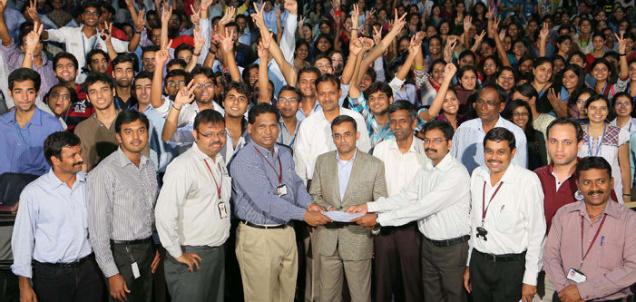
Accenture, Wipro, Cognizant Vice-Presidents handing over offer letters to students at VIT Campus in Vellore.
Accenture and Wipro have come back with a vengeance to recruit from campuses. They compensated for the lacklustre hiring from the usual mass recruiter Cognizant Technology Solutions at VIT University, Vellore, which annually churns out nearly 3,000 graduates. 

On day one of the campus recruitment on Monday at VIT, about 120 km west of Chennai, Accenture made 1,492 job offers to students as against just 90 last year. Media reports say that for the global software major, out of its 2.50 lakh global employee base, nearly one-third is in India. 

Similarly, Wipro made 1,308 job offers this year compared to just 130 last year. 

In contrast, Cognizant’s numbers declined by more than half to 803 as against 1,920 offers last year, according to the university. Tata Consultancy Services did not visit the university for the last two years. Infosys is also not visiting this year, said university sources. It is reliably learnt that at Sastra University in Thanjavur in south Tamil Nadu, on day one of the campus recruitment, TCS made offers to 863 students. Last year, the company created a record by recruiting 1,755 students from this university.

‘Feeling the heat’

VIT’s Vice-President G. V. Sampath said that despite the bad market conditions, the institution was able to place students with companies. In a recession-like scenario, every company wants to cut 50 per cent in recruitment and institutions are feeling the heat, he told Business Line. 

Samuel Rajkumar, Deputy Director of the university’s placement cell, said Flipkart had offered an annual pay package of Rs 12.5 lakh while D.E. Shaw, a software company, which is yet to conduct its recruitment drive, has offered Rs 14.5 lakh. 

A total of 55 companies have conducted placement drives. Rajkumar said that every year 150 to 160 companies visit the university. “Last year, 188 companies came and we are trying to get as many this year. In fact, last year our placement accounted for 95 per cent placing 3,007 students. The overall numbers this year could be due to the slowdown,” he said.

12 September 2012

Wipro Infotech inks deal with Qatar Airways

Wipro Infotech, the India and Middle East IT Business unit of Wipro, on Wednesday said it has inked a multi-year, multi-million dollar engagement with Qatar Airways.

The partnership is aimed at leveraging competencies of both organisations to create greater value and more efficiency for the global airline, Wipro said in a statement.

Wipro will use its experience in application development and project management and Qatar Airways’ aviation systems’ expertise to develop new solutions to create competitive advantage for the airline, it added.
Though the company declined to comment on the deal size, industry sources suggest the deal could be worth a little less than $50 million.

The Doha-based airline has a fleet of 111 aircraft flying to 118 destinations across Europe, Middle East, Africa, Asia Pacific and the Americas.

The solutions jointly developed within this partnership will enable Qatar Airways and its subsidiaries to pursue their aggressive growth strategies, the statement said.

“Through this agreement, Wipro will work with us to build new aviation IT solutions to meet our business needs in a fast-moving environment,” Qatar Airways Chief Executive Officer Akbar Al Baker said.

Under the new arrangement, a lot of the software development will be carried out by Wipro in South India.
Qatar Airways will be able to tap into Wipro’s vast pool of highly technical resources, as well as research and development centres to explore and take advantage of new technological solutions, it said.

In a separate announcement, Wipro Technologies, the IT arm of Wipro, said it has been positioned as a Thought Leadership ’Best-In-Class’ in the CEB TowerGroup Outsourcing Technology Analysis Report 2012.

Wipro has been investing in domain and technology led thought leadership and has delivered innovations in areas close to the financial services business such as Customer Experience, Risk & Compliance, Channel Transformation and Analytics, it said.

“Being recognised as a thought leadership in the financial services industry demonstrates our efforts to engage with customers as a business partner, delivering innovative business solutions that go beyond the traditional ambit of an IT services provider,” Wipro Technologies SVP and Global Head (Financial Solutions) Soumitro Ghosh said.

10 September 2012

Wipro eyeing big investments in Oman

Wipro Chairman and Managing Director Azim Premji.
Wipro is looking at making Oman its next largest market in the Gulf region and is looking forward to making big investments in the country, its Chairman and Managing Director Azim Premji has said. 

During his visit to Oman, Premji said it is potentially a very important market. 

“It is a good to do business here and we have made a good entry. We think we can grow very aggressively here,” he told the Times of Oman. 

Premji met business partners and authorities during his day-long meetings in Oman, following which he left for Riyadh. 

“We wanted to know what the government would like us to do to be relevant to the country, apart from giving us business. We plan to establish the seriousness of our commitment to Oman. 

We plan to look at the presence that we have here, the presence that we are trying to build and also build on the localisation which we are doing here,” he told the newspaper. 

Wipro has key customers across Omani market segments including oil and gas, retail, banking, transportation among others. It has been in West Asia for the last 10 years. 

According to Premji, it is perhaps the fastest growing region for the company globally. 

“We have cut across most of the verticals in Oman. We feel the potential is much more than what we have tapped. We feel Oman will throw up opportunities which will be much larger than what we have been able to exploit till now. So we will continue to make investments,” he said. 

Wipro is looking to set up local capability in Oman which the company has already done in the UAE and Saudi Arabia. 

The company has also done a case study with a very important travel segment client in Oman, the details of which will be revealed soon. 

On the Indian IT industry, Premji said it will grow nicely. 

“The penetration levels are low and so the head space for demand is high and Indian companies have solid cash flows. 

They are in a position to spend. But we have to be confident and have the right proactive solutions to be able to generate the interest to spend. India is a good market for us and we concentrate a lot on it,” he said.